Qwen3.8-27B Dynamic v3.1: Which File to Download

This guide is a companion to the video Qwen3.8-27B Dynamic v3.1: Which File to Download, which is the starting point for the picker below. Watch the video first for the walkthrough, then use this page for the exact file names, the measured sizes, and the honest limits. Added research from the primary sources is labeled as such throughout, so video claims and added research never mix.
What the model is
In the video, the presenter introduces the base model in one resume: Qwen3.8-27B is a 27B dense model, not mixture of experts, with 256K native context, an Apache-2.0 license, vision built in if you grab the sidecar file, and a mid-August release. Added research from the Qwen model card: the context extends to 1M with YaRN, thinking mode is on by default with per-request off plus a reasoning_effort control, and the recommended sampling for thinking mode is temperature 1.0 with top_p 0.95 and top_k 20. The full-precision weights are about 54.7 GB across two BF16 shards, so nearly everyone runs a quant.
What Dynamic v3.1 actually changed
In the video, the presenter explains that Unsloth swapped most files in the repo under unchanged filenames in mid-November: same name, different bytes, so a file downloaded in August is not the file you download today. Added research from the Unsloth Qwen3.8 run guide and the Dynamic 3.1 page: v3.1 is explicitly a preview algorithm, the Qwen3.8-27B files swapped on Nov 10 and 11, and the Unsloth changelog shipped app v0.1.917-beta with v3.1 support on Nov 11. The v3.1 files are the two-bit range plus UD-IQ4_XS, UD-Q4_K_M, UD-Q4_K_XL, the Q5 range, and UD-Q6_K through UD-Q6_K_L, while the 1-bit files, most 3-bit files, the plain non-UD quants, the BF16 shards, and both mmproj files are unchanged. Two disputes stay labeled: whether UD-Q3_K_XL was re-cut is unresolved, and the long-context accuracy debate with the GSQ-RCO camp is vendor-vs-vendor and not reproduced here.
The claimed gains, labeled as claims
In the video, the presenter reports Unsloth's claimed gains as claims, not measurements: roughly 5 to 10 percent average accuracy at the same sizes. Added research from the Dynamic 3.1 page: Unsloth's numbers span Terminal-Bench 2.1, DeepSWE, LiveCodeBench, GPQA-Diamond, MMLU-Pro, and AIME25, with 7 of 89 Terminal-Bench tasks excluded as unpassable on Unsloth's infra. A community tester noted the v3.1 gap looks small on some points, and the bigger token-saving figures floating around belong to other releases, not Qwen3.8-27B. Nothing in this section was bench-verified here, and the guide treats it all as vendor numbers until someone reproduces them.
Which file fits your card
In the video, the presenter gives the picks per VRAM tier, measured Nov 23 2026 against the Unsloth GGUF repo, which holds about 7.8M downloads across 27 files:
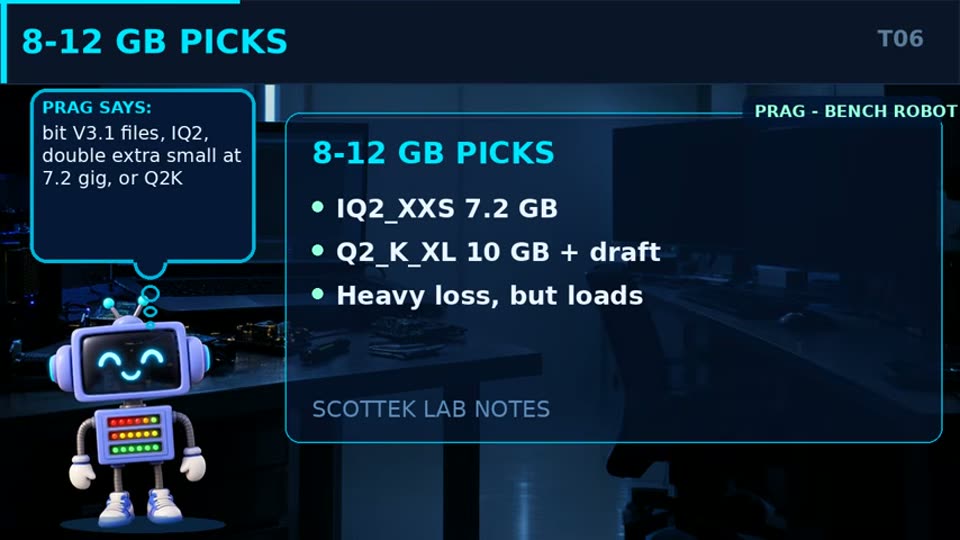
- 8 to 12 GB:
UD-IQ2_XXSat 7.21GB orUD-Q2_K_XLat 9.95GB, which carries the draft MTP layer built in. Heavy quality loss versus bigger files, but they load and they talk. - 16 GB:
UD-IQ4_XSat 14.35GB is the v3.1 pick and Unsloth's own Mac choice. Leave room for context and the KV cache or it fits on paper and dies at runtime. - 24 GB:
UD-Q4_K_XLat 17.66GB is the recommended default for a 4090 or 5080, carries the draft layer, and needs 16 to 19 GB total with context. Five-bit files fit too if you run short context. - 32 GB: six-bit files around 22 to 25GB, with
UD-Q8_K_XLat 31.46GB as the near-lossless reference that practically wants 40 GB or more.
In the video, the presenter adds the context math that decides the 16 GB tier: model plus 4K context fits, while 32K context needs KV cache in 8-bit or layers drop to CPU. Added research, untested here: the -ctk q8_0 -ctv q8_0 KV-quant lever halves KV memory with negligible quality loss per community GGUF cards, so keep both sides matched for the fast path. Context is memory too, so budget it like VRAM: short context on small cards, long context is a big-card game. Added research from the repo listing: vision needs the mmproj sidecar at about 0.93GB, and the fallback MTP draft file costs another 1.37GB plus headroom on quants without a built-in draft layer.
What our card actually measured
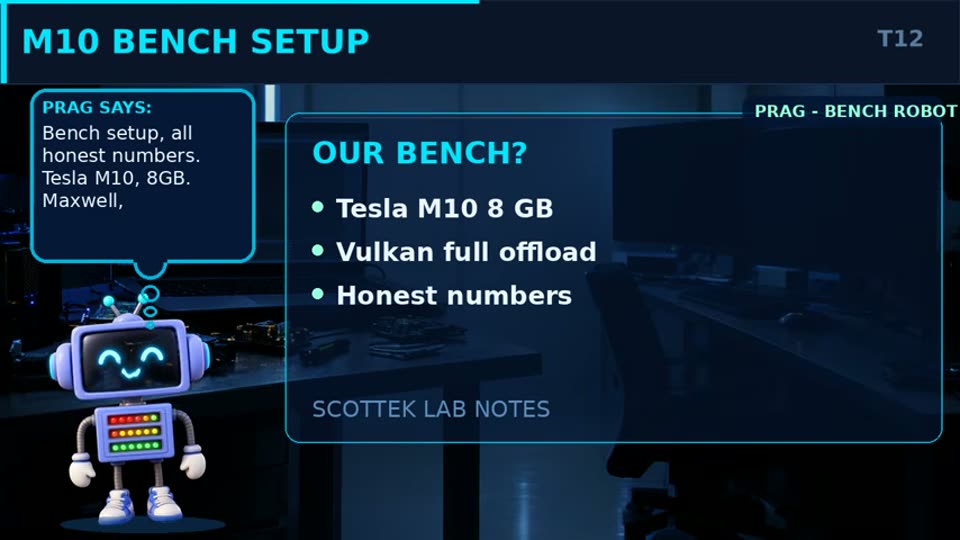
In the video, the presenter shows the bench setup with all honest numbers: a Tesla M10 with 8 GB, Maxwell, no half precision, through Vulkan on llama.cpp build b7990, running the 2-bit v3.1 file with all 65 of 65 layers offloaded, about 6549MiB of model VRAM and 7498MiB total used, at 4K context. Added research from the bench notes: the UD-Q4_K_XL file at 17.66GB was downloaded and size-verified but is not benchable on an 8 GB card, so its fit numbers stay in the vendor-table column.
In the video, the presenter reports the bench results: the exact-phrase test passed verbatim, prefill ran at about 2.3 tokens per second, decode at about 1.8, and a quality probe answered a quant-choice question correctly in one line. Slow silicon, real numbers, no cherry-picking: the model loads, talks, and reasons at 2-bit on a card from 2015. Usable for chat and short answers, just slow; long reports belong in an overnight batch or on bigger silicon.
The thinking trap that bit twice
In the video, the presenter warns about the finding that already bit the bench twice: with thinking on and a 32-token cap, the model spent all 32 tokens reasoning and returned empty content. Raise the token budget or append no-think for short answers, or you will stare at blank output and blame the quant. This one is bench-verified, not theory, and it matches the prior bench lesson exactly.
Which runtime wins, and the traps
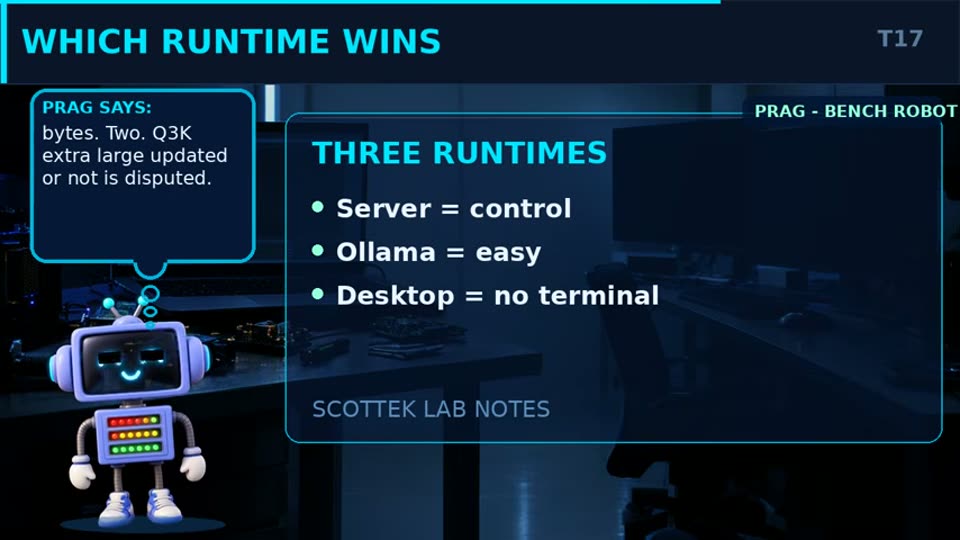
In the video, the presenter lays out three paths: llama.cpp build b7990 or newer for control and the bench numbers in the video, Ollama for convenience with the official tag, and Unsloth Desktop for no terminal at all. Added research: llama.cpp added the architecture in b7990 and draft-layer decoding in b9180, while the official Ollama model needs Ollama 0.32.12 or newer. The ollama pull hf.co/unsloth/... pattern for any single file is documented but untested here, as is the Desktop path.
In the video, the presenter names the traps before downloading. The hash-cache trap: llama-server -hf caches by hash key, so re-pull after Nov 11 or you run stale August bytes, and anything downloaded before Nov 11 should be re-pulled regardless of path. The UD-Q3_K_XL dispute above means verifying by hash before claiming anything about that file. Added research, unverified here: llama.cpp issue 27756 reports silent empty output past roughly 130K prompt positions, so reproduce or avoid long-context demos until that report is confirmed or cleared.
Verdict
In the video, the closing verdict is one line per card: 24 GB takes UD-Q4_K_XL and stops thinking, 16 GB takes UD-IQ4_XS with short context, and 8 to 12 GB takes the 2-bit v3.1 files with honest expectations. Re-pull anything from before Nov 11, budget context like VRAM, and give thinking models a real token budget. Added research from the primary sources above fills in the why; the bench proves the floor is real.